Disaster Recovery¶
The full-cluster destroy → rebuild → restore runbook. Concepts + per-PVC operations live in storage-architecture.md; the backup/restore engine (kopiur) and its exact flows live in kopiur-backup-architecture.md and kopiur-mover-permissions.md. Databases are plain Postgres + kopiur (CNPG retired 2026-08-13 — history in the plain Postgres migration doc) and use the same automatic PVC restoration. Database recovery still needs application-level acceptance; see post-restore acceptance.
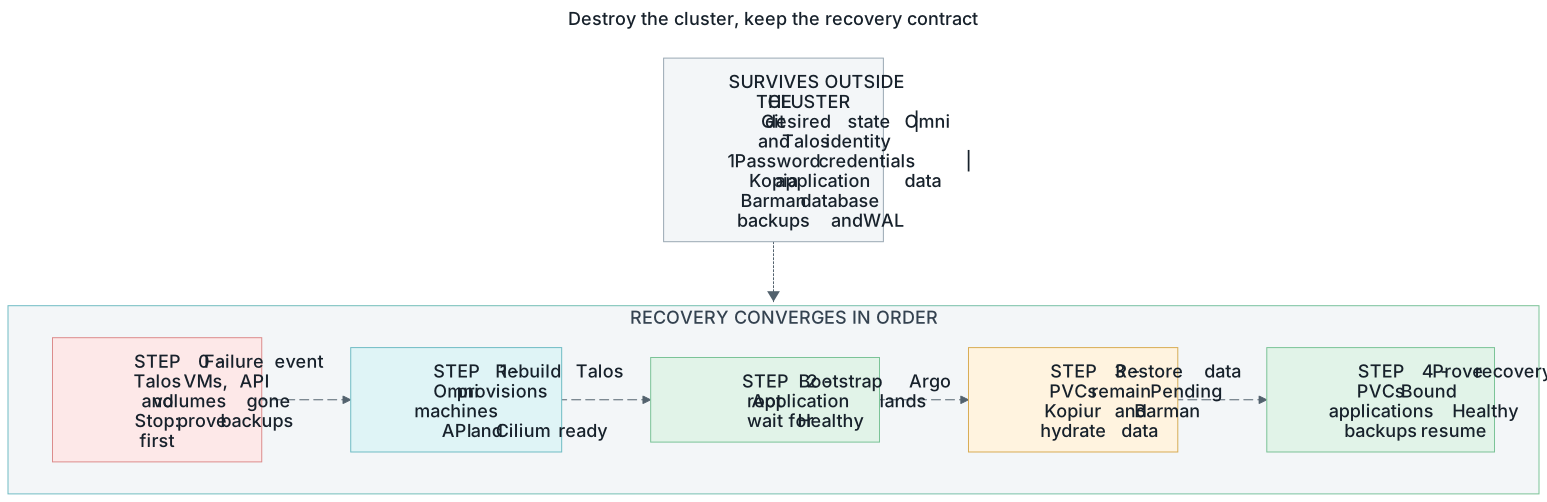
Recovery is complete only after desired state, credentials, and protected data converge and are verified. Open the full-size DR sequence.
Danger
The destructive steps require explicit operator intent. This documents the verified path; it is not an invitation to nuke during routine maintenance.
The DR model in one diagram¶
  Dies with the cluster            Survives (off-cluster)
  -----------------------          -------------------------------
  - Longhorn volumes               - Git repo
  - every Kubernetes object        - Kopia repo (RustFS S3)
  - exempt data:                   - 1Password vault
      PostHog CH/Kafka/Redis,
      Redis, scratch
                                   - Omni/Talos machine config

  Survives ==[ bootstrap-argocd.sh + sync waves ]==> New cluster
      New cluster
        ==[ kopiur Restore populators hydrate PVCs from Kopia ]==>
      All protected data back, unattended
Clusters are cattle. The Kopia repository, the Git repo, and the secrets vault are the pets. Everything between them is reconstructed automatically.
Longhorn runs the V1 engine — do not switch to V2
Interrupted rebuilds under mass-restore load corrupt V2/SPDK replica metadata (upstream #13315, #13314). Stay on V1.
Pre-nuke checklist¶
Block the nuke until every box checks — you restore from these:
- GitHub reachable; the rebuild revision pushed (ArgoCD pulls origin, not your working tree)
- GHCR image pulls work
- 1Password reachable; Connect token valid and recoverable off-cluster
- Cloudflare token valid and recoverable off-cluster
- RustFS/S3 endpoint reachable; access key registered on the external server; Kopia auth works (a past nuke proved an unregistered external credential blocks recovery even with perfect Git state)
- Talos secrets / Omni machine configs available off-cluster
- Private Docker Hub patch, in-cluster registry images and manually protected data saved off-cluster
- Backups fresh: each backed-up PVC has a recent
SucceededkopiurSnapshotyou can live with — apps roll back to exactly that snapshot. Spot-check across namespaces:kubectl get snapshot -A(look at the newest per source) and confirm noSnapshotScheduleis wedged:kubectl get snapshotschedule -A. To top up a stale one on demand:kubectl kopiur snapshot now --policy <name> -n <ns>(CLI ≥0.5.1, krew) - No PVC lacks a snapshot it expects to restore from. A first restore only hydrates if a Snapshot already exists (kopiur
onMissingSnapshot: Continuebinds a snapshot-less PVC empty and backs up forward). Confirm every PVC you intend to restore (not seed) shows at least oneSucceededSnapshot before the nuke. - Restore canary green: recent
last-drill-result=pass
Talos 1.14 rebuild¶
The template uses 1.14 Kubernetes documents for node settings and control-plane
components. It retains legacy kubelet fields for Longhorn's shared bind mount:
KubeletConfig has no extraMounts equivalent.
The existing cluster's 1.13.9 generation contract is different; use this template
after deleting that cluster.
The control plane reserves 32 GiB ETCD + 64 GiB EPHEMERAL within its existing
100 GiB disk. The GPU uses 16 GiB boot + 434 GiB EPHEMERAL on NVMe0 so Omni
selects the boot disk. Model and flash allocations stay at 450 and 300 GiB.
Check the resulting disks and mount paths with talosctl get disks,
talosctl get volumestatus and talosctl get mountstatus before restoring.
Fresh 1.14 enables workload isolation and weekly filesystem trimming. Keep
its mount defaults: the final release keeps /var executable,
so the beta secure: false workaround is unnecessary for Longhorn V1.
Rebuild sequence¶
Historical identity migration: the 2026-07-31 domain-prefix change is complete. Its merge-after-destruction step is not part of a normal rebuild. Future Application renames need a separate ownership/finalizer migration; deleting an old Application identity can prune the resources it owns.
  omnictl cluster delete
    -> wait: machines drained, VMs gone in Proxmox
    -> omnictl apply machine classes + template validate/sync
    -> machines provision from the NEW template
    -> Gateway API CRDs
    -> seed Cilium CNI
    -> seed 1Password credentials
    -> bootstrap-argocd.sh
    -> sync waves install Cilium management -> Longhorn -> kopiur -> DB support
    -> generated apps: backed-up PVCs hydrate via restore-before-bind
    -> verify application reads/writes, credentials and fresh backups
Manual pre-steps before
bootstrap-argocd.sh— the script assumes them. Follow the single canonical procedure inREADME.md§ Rebuild and Bootstrap. Skip the Cilium seed and the new cluster has no CNI (nodes stayNotReady); skip the 1Password seed and External Secrets can never start.
Ordering rule (twice-learned): machine classes and the cluster template are snapshots inside Omni — apply + sync them before machines provision, or VMs are built from stale state and must be reprovisioned. Applying a changed MachineClass does not resize or replace an already allocated VM; a replacement/full rebuild is required for its new virtual hardware to take effect.
Gate the wave train on cross-node pod networking¶
Run this after the Cilium install and before bootstrap-argocd.sh. Nodes
reaching Ready only proves the kubelet talks to the API server; it does not
prove that pods on different nodes can talk to each other. A rebuild is exactly
when that differs — new VMs, new NICs, new placement.
Every node must report 1/1 under both Node and Endpoints. Node 1/1
with Endpoints 0/1 is the trap: the node is reachable at its host IP while the
pod network to it is broken. Node-level checks, kubectl get nodes, and ICMP all
pass in that state.
Do not start the wave train with any node showing Endpoints 0/1. Sync waves
gate on pod readiness, which a broken pod network does not disturb — so the waves
proceed normally and the failures surface much later as unrelated apps stuck on
missing Secrets. Fix the network first; it is far cheaper than unwinding a
half-converged cluster.
Bootstrap rules (proven by the 2026-06 rebuilds):
- CRDs first, controllers second, CRs third.
- Observability is not a core dependency — core apps must bootstrap
without Prometheus;
kube-prometheus-stackis the sole owner ofmonitoring.coreos.comCRDs. - The kopiur operator lands at Wave 2 (
infrastructure/controllers/kopiur-operator/— installs the CRDs + operator + webhook); kopiur-config at Wave 3 (infrastructure/controllers/kopiur/— namespace, theClusterRepository cluster-kopia→ RustFSs3://kopiur, and theClusterExternalSecretcredential fan-out). Databases (Wave 4) and app backups (Wave 6) follow. The per-PVC kopiur CRs (SnapshotPolicy/SnapshotSchedule/Restore) and thekopiur.home-operations.com/repo: cluster-kopianamespace label render with each app at Wave 6. - Replica rebuilds stay throttled to 1/node
(
infrastructure/storage/longhorn/node-failure-settings.yaml) — a mass restore saturates any engine on shared homelab hardware; do not raise it mid-bootstrap.
What the restore wave looks like (calibrated expectations)¶
- Each backed-up PVC is recreated from Git with
spec.dataSourceRef → Restore
  "<pvc>-restore"
. Kubernetes withholds binding while a populatordataSourceRefis present, so the PVC sitsPendinguntil the kopiur populator restores the latest Kopia snapshot, then binds with data and the pod starts. (Full flow: kopiur-backup-architecture.md §4.) - Backend-down is fail-safe. If the Kopia repo is unreachable during a
restore, kopiur raises the backend error before the
onMissingSnapshotdecision, so the PVC staysPendingand retries — it never binds empty over a black-holed backend. The one case that does bind empty is a brand-new PVC with no snapshot yet while the repo is reachable (onMissingSnapshot: Continue= deploy-or-restore) — which is why the pre-nuke checklist insists a Snapshot exists for anything you intend to restore. - Historical rebuilds of roughly 24 PVCs took about an hour. Current app count, data size, placement and storage load differ; this is a reference measurement, not a current recovery-time guarantee.
- PostHog adds ~nothing to the wave: only
postgres-datarestores (~165 MB actual — seconds to hydrate). Its ClickHouse/Kafka/Redis rebuild empty by design; PostHog's rebuild cost is the migrate Job re-creating the ClickHouse schema (minutes), not data movement. - Past restore bursts increased etcd fsync latency and caused API readiness and leader-election failures. Watch those symptoms during recovery; persistent failures require investigating storage latency and node health. Do not assume every API failure is harmless restore load.
- A few movers may hit cross-node attach conflicts ("volume is currently attached to a different node") as Jobs recreate pods — Longhorn's attachment reconciler clears these; the last stragglers land as load drains.
- Verdict signals that something is actually wrong: a kopiur mover Job in
Failed, aRestorestuck without ever populating its PVC (PVCPendinglong after the repo is confirmed reachable), or aSnapshotstuck in error. Watch withkubectl -n <ns> get snapshotpolicy,snapshotschedule,restore,snapshot. - A
FailedRestore is terminal — kopiur never retries it. A mover pod stuck Unschedulable pastfailurePolicy.podStartupDeadlineSecondsfails the CR withMoverPodWedged, and no spec change or Argo sync resets it — an infra outage during the restore wave can fail every Restore at once. Recovery: delete the Failed CRs and let Argo recreate them — each fresh CR pins the then-latest snapshot; the unbound PVC is untouched throughout.
kubectl get restore -A --no-headers | awk '$3=="Failed" {system("kubectl -n "$1" delete restore "$2)}'
privileged-movers annotation event when the
namespace and CRs land together (exactly the DR cold-start timing) and leave
MoverPermitted=False until a ~5 min backstop requeue. If a Restore there
sits blocked well past that, nudge it: kubectl -n <ns> annotate restore
<name> kopiur.home-operations.com/kick="$(date +%s)" (any no-op metadata
touch retriggers reconcile).
In-cluster registry and Gitea Actions¶
registry.vanillax.me is an in-cluster registry backed by cluster storage.
After a full nuke, the registry pod, Service, and HTTPRoute can all be healthy
while the registry catalog is still empty. Any workload pinned to
registry.vanillax.me/... will then fail with ImagePullBackOff until those
images are rebuilt or repushed.
Check the catalog from inside the registry pod:
Restore Gitea first, then get the Gitea Actions runner online. The runner
needs Secret/gitea-actions/act-runner-token; Git declares that as an
ExternalSecret and 1Password stores the generated token:
- vault:
homelab-prod - item:
gitea-actions - field:
act_runner_token
Generate or rotate the token from the restored Gitea pod:
If 1Password is not updated yet, this manual patch gets the live runner moving:
TOKEN="$(kubectl exec -n gitea deploy/gitea -- \
  gitea actions generate-runner-token | tail -n 1 | tr -d '\r\n')"
kubectl create secret generic act-runner-token \
  -n gitea-actions \
  --from-literal=token="$TOKEN" \
  --dry-run=client -o yaml | kubectl apply -f -
kubectl rollout restart -n gitea-actions deploy/act-runner
kubectl logs -n gitea-actions deploy/act-runner -c runner --tail=50
Expected runner log:
For radar-ng, the recovery images are pinned in
my-apps/development/radar-ng/. If the registry is empty and the runner is not
usable yet, manually refill the exact pinned tags from local checkouts:
cd ~/programming/radar-ng/backend
VERSION=v1.1.4 ./scripts/build-push.sh tile-server
VERSION=v1.1.1 ./scripts/build-push.sh basemap open-meteo-worker
VERSION=v1.1.7 ./scripts/build-push.sh temporal-worker

cd ~/programming/talos-argocd-proxmox
./scripts/build-push-custom-apps.sh basemap-bootstrap
kubectl -n radar-ng delete job basemap-bootstrap
kubectl -n radar-ng rollout restart deploy/tile-server deploy/basemap deploy/open-meteo
kubectl -n radar-ng delete pod -l app=radar-ng-worker
An Insufficient cpu scheduling event means requests exceed an eligible node's
available allocatable CPU. Inspect affinity, taints and requests across eligible
nodes; low host utilization alone does not make a pod schedulable. Verify with:
kubectl describe node <eligible-node> \
  | sed -n '/Allocated resources:/,/Events:/p'
kubectl top nodes
Post-restore acceptance¶
Record all three acceptance checks, with live evidence:
- Restore contract: every backed-up PVC
Boundvia its kopiurRestorepopulator (none stuckPending), and the first post-restoreSnapshotfor each source reachesSucceeded. Cross-check per namespace:kubectl -n <ns> get pvc,restore,snapshot. -
Exemption hygiene: every intentionally backup-exempt PVC is still bound and still carries the fully-qualified
storage.vanillax.dev/backup-exempt-reasonannotation — non-zero isn't a restore failure but it masks real problems (history: two exempt PVCs once sat unnoticed because acceptance only quoted the protected counters). PostHog's ClickHouse/Kafka/Redis, standalone Redis, andproject-nomad/nomad-storageare the expected exempt set (PostHog'spostgres-datais protected — it carries the API keys/dashboards). -
Application recovery: a Bound PVC is necessary but not sufficient. Check Postgres accepts authenticated connections and the app can read existing data and complete a normal write. Verify Gitea can read a known repository and its database, Paperless can retrieve an existing document, and Temporal can complete a new workflow/timer. For apps with separate file/database PVCs, confirm both restore points describe compatible data. Validate restored credentials against 1Password before treating an authentication failure as data corruption.
The restore canary¶
Point-in-time acceptance rots; the canary provides a safe, isolated place to repeat the proof.
my-apps/system/restore-canary/ re-runs the real DR path against a dedicated test
PVC: its kopiur/restore-canary-data.yaml stub carries the SnapshotPolicy +
SnapshotSchedule + Restore, and the PVC's dataSourceRef points at the Restore.
The SnapshotSchedule keeps a fresh snapshot and a weekly quick verification
checks repository blobs. Those automated checks do not prove a restore. To
drill the full path, write and hash a sentinel, force and wait for a successful
snapshot, delete the canary PVC and its Restore CR, and let Argo recreate
both so the populator re-hydrates the PVC:
sentinel (new UID + sha256) → forced kopiur Snapshot
→ delete the canary PVC AND restore-canary-data-restore
→ Git/Argo recreate both → Restore re-resolves to the new snapshot
→ kopiur populator restore → byte-identical verification
Delete the Restore CR too — the drill is invalid without it. A Restore
resolves its source once, at admission, and never re-resolves
(status.resolved is pinned; offset: 0 means "latest as of admission", not
"latest now"). Delete only the PVC and the populator replays whatever snapshot
the Restore pinned on first use, so the drill reports RestoreSucceeded
against frozen data regardless of whether backups work. Every drill between
2026-08-03 and 2026-08-13 restored a 2026-06-10 sentinel this way and still
passed its own success check.
Gate the verdict on the pin before the bytes:
kubectl -n restore-canary get restore restore-canary-data-restore \
  -o jsonpath='{.status.resolved.pinnedAt} {.status.resolved.kopiaSnapshotID}'
pinnedAt must be newer than the drill snapshot. A healthy drill moves
Pending → Restoring → Bound; a PVC that binds instantly never ran the
populator, and a TargetAlreadyBound reason means the Restore short-circuited
because the PVC still existed.
A manually executed passing drill proves the entire chain — Git render, kopiur CR wiring,
kopia round-trip, populator restore — with data integrity checked by hash,
never touching production PVCs. Results land as
restore-canary.vanillax.dev/last-drill-* annotations on the namespace.
Treat a missing or stale last-drill-* annotation as “restore not recently
proven,” even when snapshots and quick verification are green. Automating the
destructive PVC deletion is intentionally deferred until a kopiur-native,
namespace-contained drill helper has been reviewed.
What it does not prove: restores of backups older than its own, or app-level data semantics — drill those separately when they matter.
Failure-mode catalog¶
Worked fixes for the things a hostile rebuild throws at you — stale CSI attachments, read-only filesystems, wedged clone PVCs, finalizer-stuck resources — live in the common failure modes table.