Storage, Backup & Restore Architecture¶
The operator's reference for how application data survives anything in this cluster — including the cluster itself ceasing to exist.
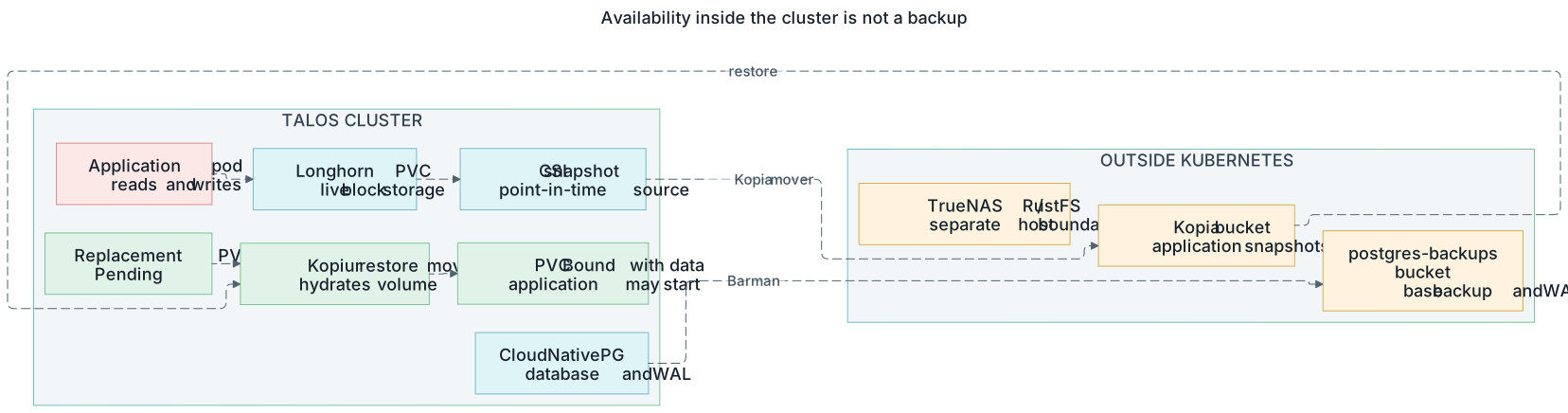
Longhorn provides live availability inside Kubernetes; RustFS provides the recoverable copy outside it. Open the full-size storage diagram.
Scope
Application PVCs (Longhorn → kopiur/Kopia → RustFS S3) — which since the CNPG retirement (2026-08-13) includes every database. The old Barman buckets are aging out under the RustFS lifecycle policy.
Related pages
- The story, from zero — pitch, plain English, talk tracks, the adoption ladder, FAQ: the easy guide.
- The mechanism — CR shapes, component composition, flow diagrams, add-a-backup checklist: kopiur backup architecture.
- The #1 gotcha — why the mover runs as the data owner: mover permissions.
- The backend — S3 box, bucket, credentials,
ClusterRepository: backup repository setup. - Full-cluster rebuild — disaster recovery.
- This page — the reference: what exists, the design decisions, day-2 operations, troubleshooting, portability, honest limitations.
Contents¶
- The bundle (quick start) · Why this exists
- What happens when a PVC is created · If this, then that
- Architecture at a glance · Design decisions · The scenarios
- Schedules & repository
- Operations: enable · exempt · restore drill · evacuate Dell
- Troubleshooting · Adapting this to your cluster · Known limitations
- Files reference
The bundle (quick start)¶
Backups are per-PVC CRs (SnapshotPolicy + SnapshotSchedule +
Restore), kept DRY by the shared Kustomize component
(my-apps/common/kopiur-backup) that injects every uniform field. Each PVC
needs a small stub plus three one-line edits:
# namespace.yaml — opt the namespace in (creds fanout + repo tenancy)
metadata:
  labels:
    kopiur.home-operations.com/repo: cluster-kopia
  annotations:
    kopiur.home-operations.com/privileged-movers: "true"  # ONLY if the mover runs as root (uid 0)

# pvc.yaml — restore-before-bind pointer
apiVersion: v1
kind: PersistentVolumeClaim
metadata:
  name: storage
  namespace: my-app
  annotations:
    argocd.argoproj.io/compare-options: ServerSideDiff=false   # immutable dataSourceRef diff mask
    argocd.argoproj.io/sync-options: ServerSideApply=false
spec:
  accessModes: [ReadWriteOnce]
  storageClassName: longhorn            # snapshot-capable CSI required
  resources: { requests: { storage: 10Gi } }
  dataSourceRef:                        # ← the line that makes DR automatic
    apiGroup: kopiur.home-operations.com
    kind: Restore
    name: storage-restore

# kopiur/storage.yaml — the stub (varying bits ONLY; the component injects the rest):
#   SnapshotPolicy   { name, sources.pvc, identity{username,hostname}, retention, mover SC = DATA OWNER }
#   SnapshotSchedule { schedule.cron }
#   Restore          { source.fromPolicy, mover SC = DATA OWNER }

# kustomization.yaml
components: [ ../../common/kopiur-backup ]
resources:  [ kopiur/storage.yaml ]
Backups run on the stub's cron; delete the PVC (or the whole cluster) and it comes back with its data.
The single non-obvious field
The mover securityContext must be the UID:GID that owns the data on
disk — the component cannot set it because ownership varies per PVC. Full
explanation: mover permissions.
Full annotated checklist:
kopiur backup architecture §5.
One-time backend prerequisite:
backup repository setup.
Why this exists (one paragraph)¶
Nuke the entire cluster, redeploy from Git, and every app comes back with its
data — no restore scripts, no snapshot IDs, no ordering choreography. Per-PVC
restore is the mechanism; cluster rebuild is the use case. Day-zero install
and day-N disaster recovery are the same code path; the only difference is
whether the repo has a snapshot for that PVC (onMissingSnapshot: Continue
binds fresh when there isn't one). Scheduled backup verification plus explicit
restore canary drills keep "restores
work" a measured fact between disasters. For the full narrative, read
the easy guide.
What happens when a PVC is created¶
The whole behavior, first install or rebuild or "oops", in one diagram:
  PVC created from Git
    |
    +-- dataSourceRef -> Restore ?
        |
        +-- YES (-> <pvc>-restore)
        |     K8s withholds binding (PVC = Pending)
        |       -> kopiur Restore populator:
        |            - snapshot exists        -> mover restores latest
        |            |                           -> PVC Bound with prior data
        |            - no snapshot             -> binds empty, backs up forward
        |            |   (onMissingSnapshot:      (disposable)
        |            |    Continue)
        |            - backend unreachable     -> errors + retries, stays
        |                                         Pending -- never empty
        |
        +-- NO bundle
              Longhorn provisions empty
                -> intentional?
                     - backup-exempt / disposable -> fine, disposable
                     - no                          -> DR GAP: add the
                                                       kopiur bundle
The single most important rule in this whole system
A PVC with no dataSourceRef → Restore recreates EMPTY. The backup
still exists in Kopia — but nothing tells Kubernetes to restore it. Git
must carry the dataSourceRef (and the matching Restore CR) for a
volume to be DR-complete. There is no operator-side ledger watching for
this gap; CI hard-fails the wired-but-broken case (see
limitations), and Git review is the
guardrail for the no-bundle-at-all case.
If this, then that¶
The whole behaviour as a flat lookup table:
| You do this | What happens |
|---|---|
Add the namespace label + the kopiur stub + a dataSourceRef → <pvc>-restore |
kopiur reconciles the SnapshotPolicy/SnapshotSchedule/Restore. Backups run on the stub's cron. |
| Recreate that PVC — same cluster or a brand-new one | The Restore populator restores it from the latest snapshot before the app starts. No human action. |
| Delete the app from Git, re-add it next month | Same as above. Your "oops" undoes itself. |
| Whole cluster gets nuked | Every PVC carrying a dataSourceRef auto-restores during bootstrap, in parallel. |
| Recreate a PVC that has no snapshot yet | onMissingSnapshot: Continue → binds empty and starts backing up forward. |
| RustFS/S3 is down when a PVC is recreated | The Restore populator errors and retries; the PVC holds Pending. It never binds empty against a black-holed repo. |
Label a PVC backup-exempt: "true" + a fully-qualified reason annotation |
You deliberately ship no kopiur bundle. It recreates empty, by recorded decision. |
Use the bare backup-exempt-reason key instead of the fully-qualified one |
The bare key records nothing and nothing at runtime enforces it. CI (validate-kopiur-coverage.py) warns on it. Always use the fully-qualified storage.vanillax.dev/backup-exempt-reason. |
Add the kopiur label/stub to a system namespace (kube-system, argocd, longhorn-system, kopiur-system) |
Don't. System namespaces are not opted in. |
Mover fails with PermissionDenied |
Its securityContext UID isn't the data owner. Fix the stub's mover UID:GID — mover permissions. |
Architecture at a glance¶
  Secrets (infrastructure/controllers/kopiur)
    1Password vault -> ClusterSecretStore -> ClusterExternalSecret
                                             (kopiur-rustfs -> every
                                              labeled namespace)
                                                    |
                                                    v
  kopiur-config (Wave 3)                       mover Jobs (as the data owner)
    ClusterRepository cluster-kopia                 |  ^
       |                                            |  | (creds)
       v                                            v  |
  kopiur operator (Wave 2)  --launches-->  ---------+  |
    reconciles SnapshotPolicy /                     |  |
    SnapshotSchedule / Restore /                    |  |
    Snapshot CRs                                     |  |
       |                                             |  |
       | takes                                       |  +-- Longhorn (V1 engine)
       v                                             |         RWO volumes +
  CSI VolumeSnapshot -> VolumeSnapshotClass          |         CSI snapshots
                        longhorn-snapclass           |
                        (Wave 3)                      v
                                          RustFS S3 (192.168.10.133:30292)
                                            bucket: kopiur
                                            snapshots keyed by identity
Who provides what¶
| Piece | Scope | Role |
|---|---|---|
ClusterRepository cluster-kopia |
cluster | the Kopia repo definition → RustFS s3://kopiur (dedicated bucket). allowedNamespaces selector grants any namespace labeled kopiur.home-operations.com/repo=cluster-kopia. |
ClusterExternalSecret kopiur-rustfs |
cluster | fans the repo creds (AWS_ACCESS_KEY_ID/AWS_SECRET_ACCESS_KEY/KOPIA_PASSWORD) into every labeled namespace, so the in-namespace mover can reach the repo. |
VolumeSnapshotClass longhorn-snapclass |
cluster | how CSI snapshots are taken (Longhorn); copyMethod: Snapshot references it. Lives in infrastructure/controllers/kopiur/. |
| kopiur operator | cluster | reconciles the per-PVC CRs; launches Snapshot + Restore mover Jobs. |
common/kopiur-backup component |
shared | injects the uniform fields by kind (repository, copyMethod, snapclass, schedule defaults, populator + onMissingSnapshot: Continue). |
| per-PVC stub | per-PVC | the varying bits: name, identity, retention, cron, and the mover UID:GID (= data owner). |
| namespace label | per-app | one label turns on both the creds fanout and repo tenancy. |
PVC dataSourceRef |
per-PVC | wires restore-before-bind to the Restore CR. |
Design decisions¶
No fail-closed PVC admission webhook. kopiur's webhook is scoped to its
own CRDs only, never PVCs or Pods, so an operator outage cannot block app
deployment. A missing dataSourceRef is caught by CI + Git review, not
blocked at create time. Do not add a validating/mutating webhook on PVC create
with failurePolicy: Fail — a webhook deadlock is a platform-wide single point
of failure.
Never bind empty over a black-holed backend. kopiur gives this for
free: the Restore populator raises a backend error before the "no
snapshot → empty" decision, so an outage holds the PVC Pending instead of
binding empty (source-verified: crates/controller/src/restore/mod.rs
resolve_snapshot — see
kopiur backup architecture §4).
ArgoCD is in the loop, on purpose. Two things depend on the GitOps engine: (1) something must recreate the PVC from Git — on a rebuild ArgoCD is the thing doing the creating, for every app, in parallel; and (2) sync waves make the rebuild deterministic — the backup machinery (Longhorn W1 → kopiur operator W2 → repo config W3) exists before the first protected PVC does (W4–6). Without wave ordering you get retry soup: populators waiting on CRs that don't exist, movers failing on creds that haven't fanned out. Wave table and gating mechanics: entrypoints · how Argo waits.
The scenarios¶
- Fresh cluster, brand new app. No snapshot in the repo →
onMissingSnapshot: Continuebinds the PVC empty → backups begin on schedule. - Disaster recovery — cluster nuked, repo preserved. Same Git, new
cluster. Every protected PVC carries its
dataSourceRef; the populator restores each one from its latest snapshot before its app starts, in parallel, unattended. - Oops, I deleted the app. Re-add it to Git → identical to scenario 2. The mistake fixes itself.
- New app added to an existing cluster. Same as scenario 1 — day-zero and day-N are the same code path.
- Backup backend down at recreate time. The
Restorepopulator errors and retries; the PVC holdsPending. Apps already running keep running; nothing binds empty. When RustFS returns, the populator completes.
Worked example: the complete open-webui config (all four pieces, real production YAML, tabbed) lives in the easy guide, Part 4; copyable reference apps are listed in files reference. Verify any backed-up app any time:
kubectl -n <ns> get snapshotpolicy,snapshotschedule,restore,snapshot,pvc
kubectl -n <ns> get secret kopiur-rustfs    # fanned out by the ClusterExternalSecret
Expect the three CRs present, recent Snapshot objects Succeeded with
non-zero files, and the PVC Bound.
Backup schedules, retention, repository¶
There is no tier abstraction. Each stub carries its own
SnapshotSchedule.spec.schedule.cron and its own
SnapshotPolicy.spec.retention (keepHourly/keepDaily/keepWeekly/
keepMonthly as needed). Pick a distinct cron minute per PVC to avoid a
backup stampede on the same node.
| Field | Where | Example |
|---|---|---|
| cadence | stub SnapshotSchedule.spec.schedule.cron |
"5 3 * * *" (daily 03:05), "10 * * * *" (hourly :10) |
| retention | stub SnapshotPolicy.spec.retention |
{ keepDaily: 14, keepWeekly: 6, keepMonthly: 3 } |
| concurrency | component → concurrencyPolicy: Forbid |
no overlapping snapshot Jobs |
One shared Kopia repository for the whole cluster (ClusterRepository
cluster-kopia → RustFS s3://kopiur), snapshots keyed by each policy's
identity (hostname/username). Kopia's content-defined chunking means:
recreate an app and the next backup finds every chunk already present
(near-instant, near-zero new storage); common files across apps are stored
once; storage grows with unique data, not PVC count.
The repo lives off-cluster on RustFS (S3) — the one piece of state that
must outlive any cluster. It's a dedicated kopiur bucket (the retired
CNPG/Barman postgres-backups bucket is aging out via lifecycle policy).
Operations¶
Enable a backup¶
Five steps, all in Git (full annotated checklist in
kopiur backup architecture §5,
or the /project:add-backup command):
- Find the data owner:
kubectl -n <ns> exec <pod> -- stat -c '%u:%g' <data-mountpath>. - Namespace: add label
kopiur.home-operations.com/repo: cluster-kopia(plus theprivileged-moversannotation only if the owner is0). - Stub: add
kopiur/<pvc>.yaml(SnapshotPolicy+SnapshotSchedule+Restore) with the moversecurityContextset to that UID:GID and a distinct cron minute. - PVC: add
dataSourceRef → Restore/<pvc>-restore+ the twoServerSide*annotations (the immutable-dataSourceRefdiff mask). On an already-Bound PVC expect the harmlessForbiddenComparisonError (see Troubleshooting) — backups start now, thedataSourceRefarms on next recreate. - Kustomization: add the stub to
resources:and../../common/kopiur-backuptocomponents:.
Then commit, sync, and verify:
Copy from a canonical example: my-apps/ai/open-webui/ (simple, single-UID
568), my-apps/home/project-nomad/mysql/ (daemon-drop 999:568), or
my-apps/home/home-assistant/kopiur/ (root-owned, uid 0 + the
privileged-movers annotation). Helm-rendered PVCs get the dataSourceRef
injected via Kustomize patches:.
Exempt a PVC (deliberate non-backup)¶
An exempt PVC ships no kopiur bundle at all — it is simply not protected, on purpose, with a written reason:
metadata:
  labels:
    backup-exempt: "true"
  annotations:
    storage.vanillax.dev/backup-exempt-reason: "<why>"
- The reason key must be fully qualified — the bare
backup-exempt-reasonrecords nothing, and there is no runtime admission gate. CI (validate-kopiur-coverage.py) warns on missing/unqualified reason keys; it does not block. - An exempt PVC has no
RestoreCR, so do not add adataSourceRef— a dangling one deadlocks the recreated PVCPendingforever. - An exempt PVC recreates empty after DR. That is the contract — write the reason like you're explaining it to yourself during an outage.
Back up: user content, databases, hard-to-recreate config. Exempt: caches, brokers, externally-synced data, disposable analytics (PostHog's ClickHouse/Kafka and Redis are exempt here).
Restore drill (prove it)¶
A backup that has never been restored is a hypothesis, not a recovery plan.
  confirm a Snapshot exists (non-zero files)
    -> scale app to 0
    -> delete the PVC
    -> Git recreates it (dataSourceRef -> Restore)
    -> PVC holds Pending while the populator restores
    -> binds WITH data; app starts
    -> verify a sentinel byte-identical
Warning
Before deleting, wait until ArgoCD's synced revision contains the
dataSourceRef — deleting against a stale render recreates the PVC empty.
This drill runs on demand against a dedicated test PVC — the
restore canary
(my-apps/system/restore-canary/). Its backup and quick-verification schedules
run continuously; the destructive restore remains deliberate.
Evacuate the Dell Longhorn disk¶
Purpose: move every existing Longhorn replica off Dell without permitting new placement on its old system disk. This cleared the old VM for replacement; the new dedicated Samsung SSD is a separate storage-adoption step.
Status: completed. A read-only check on 2026-08-12 returned no replicas for
the old Dell node, and every active volume reported healthy on the Threadripper
GPU worker. The replacement CPU-only Dell definition retains an unschedulable
system-disk declaration and adds the Samsung-backed dell-ssd target. The old
evacuation remains a prerequisite: do not confuse the new empty disk with the
retired system-disk replica path.
Before changing live state, identify the Dell node and prove that every active volume is healthy, its target disks have scheduling headroom, and protected PVCs have recent successful Kopiur snapshots:
DELL_STORAGE_NODE=talos-prod-cluster-v2-dell-gpu-workers-kf5x8m

kubectl get nodes "$DELL_STORAGE_NODE"
kubectl -n longhorn-system get nodes.longhorn.io "$DELL_STORAGE_NODE" -o yaml
kubectl -n longhorn-system get replicas.longhorn.io \
  -l longhornnode="$DELL_STORAGE_NODE"
kubectl -n longhorn-system get volumes.longhorn.io \
  -o custom-columns=NAME:.metadata.name,STATE:.status.state,ROBUSTNESS:.status.robustness
kubectl get snapshot.kopiur.home-operations.com -A
Expected before eviction: the Kubernetes and Longhorn nodes are ready; the
Dell replica inventory is understood; active volumes are healthy; target
Threadripper disks are schedulable with enough space for the declared replica
sizes; and protected PVCs have a recent Succeeded snapshot with non-zero
files. Stop if a volume is faulted, a protected PVC lacks a usable snapshot, or
Longhorn reports no suitable target disk.
After this Git revision is the desired state:
- In Longhorn, open Node → Dell worker → Edit Node and Disks.
- Set the
talos-ephemeraldisk's Scheduling to Disable and save. - Set that disk's Eviction Requested to
trueand save. - Watch the disk's replica count and Longhorn events. Longhorn rebuilds a replacement before evicting each replica; it also temporarily attaches a detached volume when needed.
- Stop on any rebuild or scheduling error. Cancel eviction by setting
Eviction Requested to
false; remaining replicas stay on Dell. - Success is Dell replica count
0, no active volume faulted or degraded, and the affected workloads mounted and ready. Clear Eviction Requested, but leave Scheduling disabled.
Longhorn's upstream procedure and guarantees are documented in Evicting Replicas on Disabled Disks or Nodes.
This operation does not move existing replicas onto the new Samsung SSD; normal Longhorn scheduling and any deliberate replica-count changes happen separately.
Troubleshooting¶
The debugging questions, in order¶
- Is the namespace opted in? Label
kopiur.home-operations.com/repo=cluster-kopiapresent? - Did the creds fan out?
kubectl -n <ns> get secret kopiur-rustfs. - Do the CRs exist?
SnapshotPolicy,SnapshotSchedule, andRestoreall present and reconciled? - Does the PVC carry
dataSourceRef → <pvc>-restore? (No = recreates empty.) - Did the last
Snapshotcomplete with non-zero files?
Common failure modes¶
| Symptom | Cause / fix |
|---|---|
Mover fails PermissionDenied / "unable to open file … permission denied" |
The mover securityContext UID isn't the data owner. stat -c '%u:%g' the data, set the stub's mover UID:GID to match. Mover permissions. |
Mover for a root-owned volume blocked (MoverPermitted=False) |
Namespace missing kopiur.home-operations.com/privileged-movers: "true". |
| PVC recreates empty | no dataSourceRef → Restore in Git → add the bundle (or mark exempt deliberately). |
New PVC Pending forever, no progress |
dataSourceRef points at a Restore that doesn't exist (or a wrong name). Add the Restore CR / fix the name. |
New PVC Pending, populator erroring |
backend unreachable — RustFS down, wrong endpoint/creds, or the workload key lacks read/write on the kopiur bucket. This is the safe state (never binds empty); fix the backend. |
PVC is invalid: Forbidden ComparisonError |
dataSourceRef added to a Bound PVC (immutable) — harmless; applies on next recreate. The ServerSide* annotations + AppSet ignoreDifferences mask the live diff. |
Mover stuck Init/Pending, "volume hasn't been attached" with an old VolumeAttachment |
stale CSI state — delete the mover pod; its Job retries with a fresh attach. |
Pod crashloops on read-only file system after a storage disruption |
the volume must FULLY detach to drop the stale mount: scale to 0 → wait for Longhorn volume detached → scale up (plain Postgres: scale the Deployment). |
Restored volume degraded briefly |
Longhorn rebuilding its second replica — wait, don't touch. |
Quick health commands¶
kubectl -n kopiur-system get pods,clusterrepository      # the operator + repo
kubectl get snapshotpolicy,snapshotschedule,restore -A   # all per-PVC wiring
kubectl get snapshot -A                                  # backup runs
kubectl -n <ns> get secret kopiur-rustfs                 # creds fanned out?
Adapting this to your cluster¶
(For the gradual version — "try kopiur without adopting this whole stack" — see the adoption ladder.)
You need:
- A CSI with VolumeSnapshot support (
kubectl get volumesnapshotclassmust return something). Longhorn here; Rook/Ceph, OpenEBS, TopoLVM all work. local-path-provisioner does not. - kopiur — the Kopia-native
operator (the
Restorepopulator is the load-bearing piece for restore-before-bind). - An S3 (or filesystem) target for Kopia that lives outside the cluster, and a way to deliver its password as a Secret (ESO + anything, sealed-secrets, or a plain Secret). The one-time backend setup is in backup-repository-setup.md.
- A GitOps engine helps (the restore-on-recreate flow leans on "Git recreates
the PVC"), but
kubectl applyworks too. - Optionally, a thin DRY layer over the per-PVC CRs — here, the
my-apps/common/kopiur-backupKustomize component (the Flux analog is a reusablecomponents/bundle).
Swappable: everything else. Talos→any k8s, Cilium→any CNI, ArgoCD→Flux, Longhorn→any snapshot CSI, RustFS→MinIO/TrueNAS/B2, 1Password→any secret backend.
Known limitations and non-goals¶
This is a working homelab system, not a hardened product.
Trust model. Single-operator homelab. Threat model is "I might fat-finger a delete," not "an attacker is in my cluster." One shared Kopia password = full blast radius if leaked; acceptable because backups never leave the LAN.
3-2-1 compliance: no. RustFS is the only copy. A box-level disaster (fire, ransomware on the NAS) loses the backups. Add a second destination (rclone to B2, ZFS replication) if you need real off-site coverage.
No coverage ledger. kopiur reports on its own resources, not the negative
space. There is no map of "which PVCs lack a bundle" and no needs-human-review
parking. The automated gate is the validate-kopiur-coverage.py CI check (run
on the rendered manifest stream): it hard-fails a PR where a backed-up PVC
is missing its dataSourceRef or a backed-up namespace lacks the repo label,
and warns on uncovered+unexempt PVCs, missing mover securityContexts, and
unqualified exempt reasons. A PVC with no bundle at all is therefore only a
warning — Git review and the worked examples remain the guardrail for the
negative space.
Pre-1.0 engine. Kopiur CRD fields can change between releases. The chart
pin lives in infrastructure/controllers/kopiur-operator/kustomization.yaml.
Review the versioned CRDs and recovery behavior when upgrading it.
Recoverable data age is the age of the latest successful snapshot. An hourly schedule is a target, not a guaranteed one-hour loss bound: delayed or failed snapshots make it older. Databases use crash-consistent filesystem snapshots with Postgres WAL recovery, not continuous WAL archiving or PITR.
The canary proves the storage loop, not every application. Its scheduled backups run automatically; the destructive restore drill is deliberately invoked by the operator. Postgres does use this backup path. A consistent snapshot containing PGDATA and its WAL permits crash recovery. Restored applications still need read/write checks, and apps spanning several PVCs need compatible file and database restore points. See post-restore acceptance.
Files reference¶
| Concern | Path |
|---|---|
| kopiur operator (Helm chart Application) | infrastructure/controllers/argocd/apps/core-dependencies/kopiur-operator-app.yaml → infrastructure/controllers/kopiur-operator/ |
| kopiur config (ClusterRepository, creds ClusterES, snapclass) | infrastructure/controllers/kopiur/ + …/core-dependencies/kopiur-config-app.yaml |
| Shared backup component (uniform fields) | my-apps/common/kopiur-backup/ |
| Longhorn + rebuild throttle | infrastructure/storage/longhorn/ (node-failure-settings.yaml) |
| App PVCs + per-PVC stubs | my-apps/<category>/<app>/pvc.yaml + …/kopiur/<pvc>.yaml |
| Simple example (single UID 568) | my-apps/ai/open-webui/ |
| Daemon-drop example (uid 999:568) | my-apps/home/project-nomad/mysql/ |
| Root-owned example (uid 0) | my-apps/home/home-assistant/kopiur/ |
| Restore canary | my-apps/system/restore-canary/ |
| Operator source | home-operations/kopiur |
| Mechanism docs | kopiur backup architecture · mover permissions · evaluation · trial |