kopiur backup architecture — the instruction manual¶
How the pieces fit together for backup and restore, and which part lives where. If you're new to Kustomize components, start at §2 — that's the bit that trips people up. Permissions deep-dive:
kopiur-mover-permissions.md.
kopiur is the cluster's backup system: a Kopia-native operator. You declare small CRs, it runs Jobs, kopia moves bytes to RustFS.
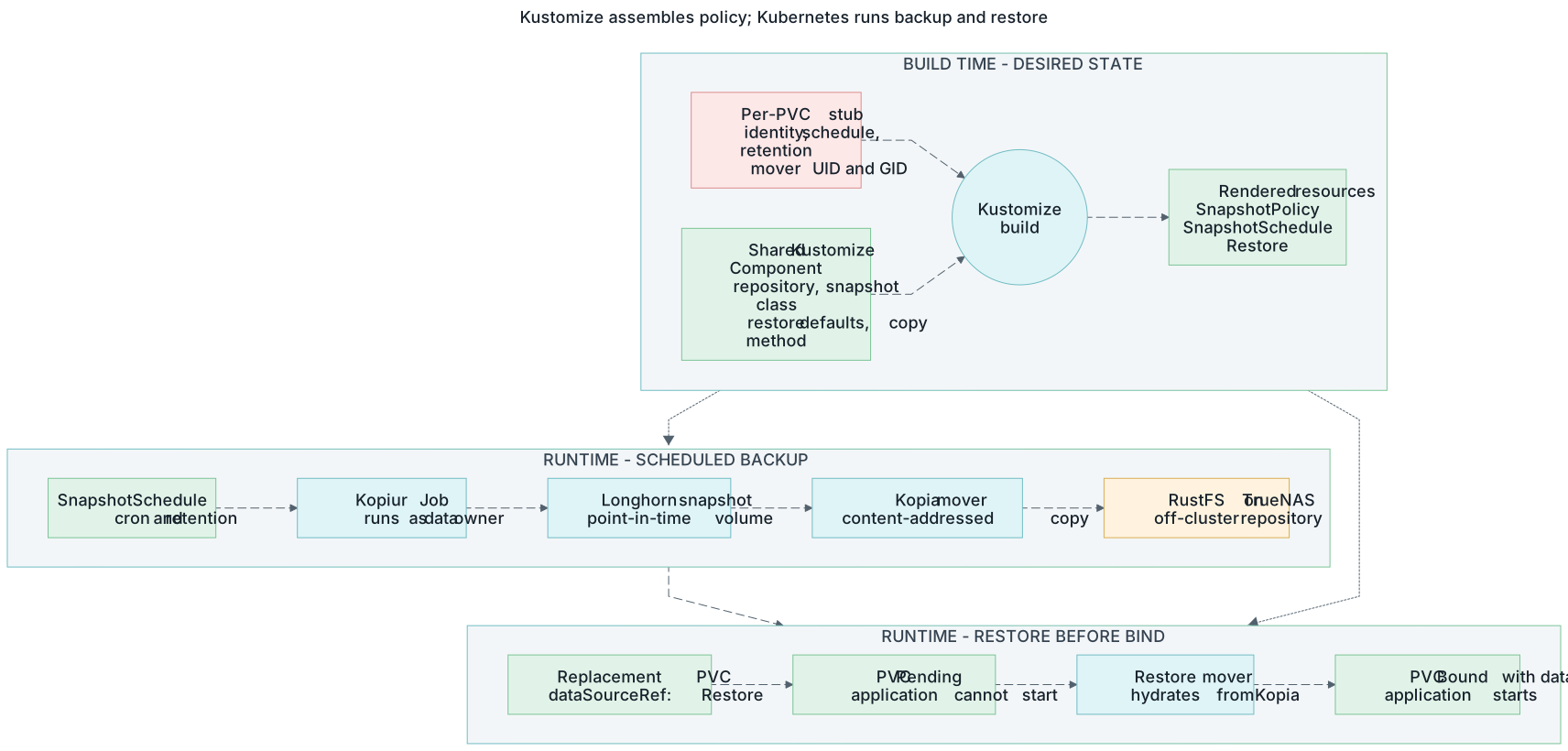
The app stub owns what varies per PVC; the shared Component adds cluster-wide defaults. Kustomize renders complete resources for Argo CD, and those resources drive both the scheduled backup and restore-before-bind paths.
Lifecycle and Flows¶
-
1. GitOps & Kustomize Assembly
Build time- The app stub declares the policy, schedule, restore target, and mover UID:GID.
- The shared kopiur component adds the repository, copy method, and volume-populator settings.
- ArgoCD combines both with Kustomize and applies the rendered resources to Kubernetes.
-
2. Scheduled Backup
Runtime- A SnapshotSchedule creates a Snapshot custom resource.
- The kopiur operator takes a Longhorn CSI snapshot and starts a mover Job as the data owner.
- The mover reads S3 credentials from
kopiur-rustfsand uploads encrypted, deduplicated data tos3://kopiur.
-
3. Restore Before Bind
Disaster recovery- ArgoCD recreates a PVC that references a kopiur Restore.
- Kubernetes keeps the PVC
Pendingwhile the restore populator starts a mover Job. - The mover restores data from RustFS; only then does Kubernetes bind the PVC and start the application.
1. The pieces (what exists, and where)¶
Cluster-wide — set up once
infrastructure/controllers/kopiur/defines thecluster-kopiarepository, thekopiur-rustfscredential fanout, andlonghorn-snapclass.- The operator in
kopiur-systemwatches kopiur resources and runs snapshot and restore Jobs. my-apps/common/kopiur-backup/holds the shared Kustomize component.
Per app — add for every protected PVC
- Label
namespace.yamlto receive repository credentials. - Point
pvc.yamlat the Restore withdataSourceRef. - Add the
kopiur/<pvc>.yamlstub. - Include the stub under
resources:and the shared component undercomponents:inkustomization.yaml.
| Piece | Scope | What it does |
|---|---|---|
ClusterRepository cluster-kopia |
cluster | the kopia repo definition → RustFS s3://kopiur |
ClusterExternalSecret kopiur-rustfs |
cluster | fans the repo creds into any namespace labeled kopiur.home-operations.com/repo: cluster-kopia |
VolumeSnapshotClass longhorn-snapclass |
cluster | how CSI snapshots are taken (Longhorn) |
| kopiur operator | cluster | reconciles the CRs; launches the mover Jobs |
component common/kopiur-backup |
shared | injects the uniform fields into your stub |
stub kopiur/<pvc>.yaml |
per-PVC | the varying bits: name, identity, cron, mover UID |
| namespace label | per-app | turns on creds + repo access for that namespace |
PVC dataSourceRef |
per-PVC | wires restore-before-bind to the Restore |
2. How a Kustomize component composes (read this if components are new)¶
A component is a reusable bundle of patches. Your app's kustomization.yaml
"pulls it in" with components:. At build time Kustomize takes the resources you
list, then lets the component patch them. So the per-PVC stub stays tiny (just
the bits that differ); the component fills in everything that's the same for every
backup.
In plain English: the app explicitly opts into the Component. Kustomize loads the app's resources, finds the Kubernetes objects targeted by the Component, adds the shared fields in memory, and prints complete YAML. Argo CD then compares and applies that rendered YAML.
Kustomize parses the YAML into structured Kubernetes objects, matches the
Component patches to resources by API group and kind, applies JSON Patch
operations to exact object paths such as /spec/repository, and serializes the
result as complete YAML. Neither source file is rewritten. Components are a
first-class Kustomize feature intended to package reusable, opt-in configuration,
not a repository workaround (upstream Components example).
It does not automatically run because a certain filename exists. The app's
kustomization.yaml is the build entrypoint and must explicitly list the
Component under components:. The Component then sees the resources accumulated
by that app and transforms matching objects. It is not a parent manifest and it
does not run independently.
Is this like Kyverno?¶
No. The outcome can look similar because both tools can add fields, but they run at different times and own different boundaries:
| Kustomize Component | Kyverno policy |
|---|---|
Runs during kustomize build, before submission |
Runs inside the cluster during admission/background reconciliation |
Explicitly included by an app's components: list |
Watches API requests or existing cluster resources |
| Produces the desired YAML that Argo CD compares and applies | Validates or mutates resources as they enter or live in the cluster |
| No controller remains running for the Component | Kyverno controllers must remain running |
With Argo CD, the actual path is:
Git files -> Argo CD repo-server -> kustomize build
          -> rendered YAML -> Argo CD diff/apply -> Kubernetes API
kubectl apply -k <app> performs the same build-then-apply sequence locally.
Conceptually, the build does this:
function applyKopiurComponent(resource) {
  // Kustomize works on parsed objects, not raw text or filenames.
  const output = structuredClone(resource);

  const isSnapshotPolicy =
    output.apiVersion.startsWith("kopiur.home-operations.com/") &&
    output.kind === "SnapshotPolicy";

  if (isSnapshotPolicy) {
    output.spec.copyMethod = "Snapshot";
    output.spec.volumeSnapshotClassName = "longhorn-snapclass";
    output.spec.repository = {
      kind: "ClusterRepository",
      name: "cluster-kopia",
    };
  }

  return output;
}

const appResources = loadResourcesFromKustomization();
const renderedResources = appResources.map(applyKopiurComponent);

printYaml(renderedResources); // this is what Argo CD applies
That JavaScript is only a teaching model. Real Kustomize uses the Component's target selector and JSON Patch operations, but the data flow is equivalent. Non-matching resources pass through unchanged, and the source YAML files are not rewritten.
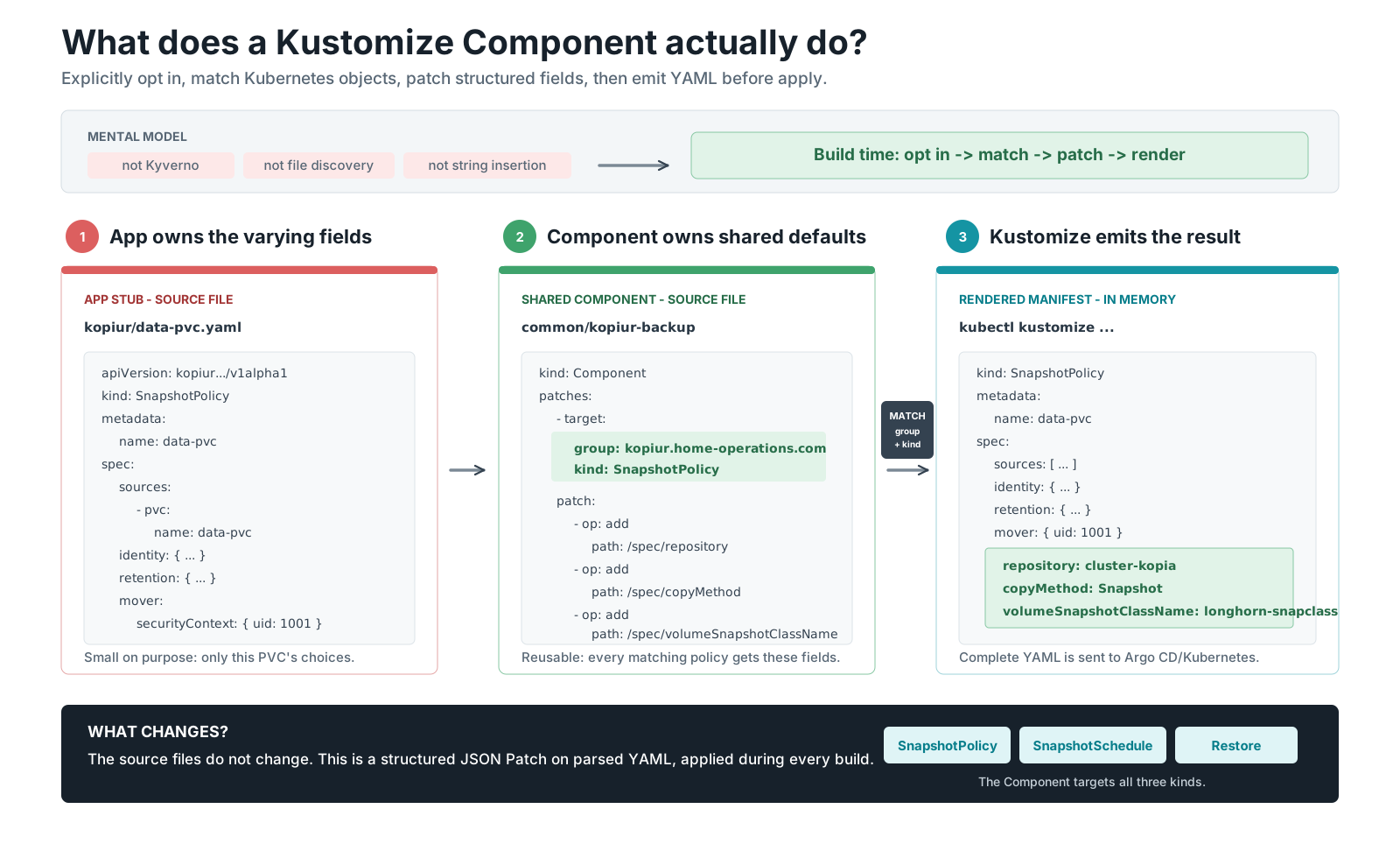
Coral fields belong to the application. Green fields are shared defaults from the Component. The rendered resource contains both before Argo CD sees it.
Open the full-size Component diagram
Why use it here?¶
Every protected PVC needs the same repository, snapshot class, copy method, restore populator, and scheduling safety defaults. Repeating those fields in every app would make drift likely and a cluster-wide change tedious. The Component makes those settings one shared policy while each app still owns its identity, retention, schedule, and mover UID.
The trade-off is visibility: the stub is not the complete deployed object when
read by itself. Use kubectl kustomize <app> to inspect the real output. Keep
varying fields out of the Component, keep targets narrow, and render every app in
CI. In this repository the Component intentionally affects every matching
SnapshotPolicy, SnapshotSchedule, and Restore included by that one app's
Kustomization; it cannot reach resources in another Argo CD Application.
Read that as: "load these resources, opt into these shared transformations, then print the combined result."
| Resource | App stub supplies | Component adds |
|---|---|---|
SnapshotPolicy |
name, source PVC, identity, retention, mover UID:GID | repository, copyMethod: Snapshot, volumeSnapshotClassName, deletion.onPolicyDelete: Retain |
SnapshotSchedule |
cron schedule | concurrencyPolicy: Forbid, runOnCreate: false |
Restore |
source policy, mover UID:GID | repository, target.populator, onMissingSnapshot: Continue |
kubectl kustomize <app> combines both sets of fields into the complete custom
resources that ArgoCD applies.
Keep the mover UID in the stub, not the component: it varies per PVC (the data owner differs app to app — even within one namespace), and a component patches all resources of a kind the same way, so it can't set a per-PVC value. The component sets only what's identical everywhere.
3. Backup flow (what happens on a schedule)¶
- A
SnapshotSchedulefires on its cron, for example10 3 * * *, and creates a Snapshot custom resource. - The kopiur operator creates a point-in-time CSI
VolumeSnapshotthroughlonghorn-snapclass. - The operator launches a mover Job as the data owner UID:GID and mounts the snapshot read-only.
- The mover reads S3 credentials from the local
kopiur-rustfsSecret, which theClusterExternalSecretplaced in the namespace. - Kopia uploads deduplicated, encrypted data to RustFS at
s3://kopiur, then marks the SnapshotSucceededwith its file and byte counts.
The mover must run as the data owner or it can't read the files — see
kopiur-mover-permissions.md.
A backup against an unreachable repo errors: the Snapshot Job fails and retries, nothing garbage is written.
4. Restore-before-bind flow (the DR magic)¶
The whole point: when a PVC is recreated, it does not come up empty — it
holds at Pending until kopiur restores its data, then binds.
- ArgoCD recreates the PVC from Git after a PVC deletion, namespace recreation, or full disaster recovery.
- The PVC's
dataSourceRefpoints to<pvc>-restore, so Kubernetes withholds binding and leaves the PVCPending. - The kopiur restore populator checks the repository and decides how to proceed.
| Repository state | Result |
|---|---|
| Reachable, snapshot exists | A mover restores the data, the PVC binds, and the pod starts. |
| Reachable, no snapshot yet | onMissingSnapshot: Continue binds an empty PVC, which backs up forward. |
| Unreachable | The restore errors and retries; the PVC stays Pending and never binds empty. |
A restore against an unreachable repo leaves the PVC
Pending— kopiur raises the backend error before the "no snapshot → empty" decision, so an outage can never bind an empty volume. (Source:crates/controller/src/restore/mod.rsresolve_snapshot.)onMissingSnapshot: Continuemeans a brand-new PVC with a reachable repo but no snapshot still binds empty and backs up forward — deploy-or-restore in one path.
5. To add a backup (checklist)¶
kubectl -n <ns> exec <pod> -- stat -c '%u:%g' <data-mountpath>→ note the owner uid:gid.- Namespace: add label
kopiur.home-operations.com/repo: cluster-kopia(+ theprivileged-moversannotation only if owner is0). - Add
kopiur/<pvc>.yamlstub (SnapshotPolicy + Schedule + Restore) with the mover set to that uid:gid; pick a distinct cron minute — check both tiers: an hourlyMM * * * *occupies minute MM of every hour, so a dailyMM 3 * * *with the same MM collides at 03:MM (caught in the 2026-07-04 audit: mysql 03:25 vs meilisearch hourly :25). List the taken minutes before picking: - PVC:
dataSourceRef -> Restore/<pvc>-restore+ the twoServerSide*annotations (argocd.argoproj.io/compare-options: ServerSideDiff=falseandargocd.argoproj.io/sync-options: ServerSideApply=false— the immutable-dataSourceRefdiff mask). Retrofitting a running app? Expected: ArgoCD shows aPVC is invalid: ForbiddenComparisonError —dataSourceRefis immutable on a Bound PVC. Harmless: backups start immediately anyway, and thedataSourceRefarms on the next recreate (which is exactly what DR is). The annotations + AppSetignoreDifferencesmask the diff. - Kustomization: add the stub to
resources:and../../common/kopiur-backuptocomponents:. - Verify:
kubectl -n <ns> get snapshotpolicy,snapshotschedule,restore,snapshot,secret.
Copy from my-apps/ai/open-webui/ (simple)
or my-apps/home/project-nomad/mysql/
(daemon-drop uid 999:568). Full step-by-step: .claude/commands/add-backup.md.
6. Upstream 0.5.x–0.8 notes (chart pinned 0.8.0)¶
What changed upstream in 0.5.0–0.8.0 and how it lands here:
- 0.8.0 adds a SnapshotPolicy deletion cascade + snapshot auto-adoption
(#272), with mass-deletion protection. Two new
SnapshotPolicyfields:spec.deletion.onPolicyDelete(Retaindefault /Delete) —Retainleaves the kopia repo snapshots when a policy is pruned (onlySnapshotCRs are GC'd). We pinRetainin thekopiur-backupcomponent: likecopyMethod, a server-defaulted field has no SSA owner, so a future default flip could let an ArgoCD prune cascade-delete backup history. Deliberate cleanup of a decommissioned app is a manualDelete.spec.adoption(Adoptdefault /Ignore) — identity-matched orphan snapshots are adopted so retention prunes them; foreign-cluster snapshots are guarded. Left at the default. CRDs are unchanged (still 8) — no stub edits needed.
- 0.7.1–0.7.5: only additive/opt-in CRD fields and features we don't use
(CLI tuning flags,
credentialProjectionnaming, multi-cluster identity, asecurityContext-inherit fix). Nothing we consume changed. - 0.7.0 = a trivial bump for us (2026-07-07). The chart's
values.yamlis byte-identical to 0.6.0, thekubeVersionfloor is unchanged (>=1.32.0-0), and the CRD set is the same 8. Its breaking changes are all internal Rust dependency upgrades (kube 4.0, croner 3.0, reqwest/rand) plus theRepositoryReplicationsync-to credential fix (#200) — which we don't use (no replication). Render-verified with our values: 20 objects, images at0.7.0,failurePolicy: Ignoreintact. - 0.5.2: transient VolumeSnapshot errors are retried, not terminal (#201). Before, a Longhorn hiccup during CSI staging burned the whole backup run.
- Failed
SnapshotCRs are terminal by design — kopiur never retries a failed run in place; the next cron fires a fresh Snapshot (partial uploads in the Kopia repo are reused, so retries are cheap). Failed CRs are pruned atfailedJobsHistoryLimit(default 10). A staging hang fails atspec.staging.timeout(default 10m, reasonStagingTimedOut). inheritSecurityContextFrom: pvcConsumer: {}exists as an alternative to hand-set mover uids — we deliberately DON'T use it: bjw-s reported it detecting the wrong consumer uid intermittently, and during a DR cold-start restore there is no consumer pod to inherit from. Explicit data-owner uids in the stubs stay the rule (kopiur-mover-permissions.md).-
0.6.0 = the breaking chart refactor (#203 → #206), bumped here 2026-07-06. Our values keys (
installScope,webhook.failurePolicy,webhook.tls.mode) kept their paths; the inertinstallCRDsline was deleted; images follow appVersion as before. New in the render: a leader-election Role/RoleBinding — benign. ⚠️ The upgrade that burned everyone else: CRDs moved from templated chart resources to Helm's nativecrds/dir, and Helm does NOT managecrds/on upgrade — Flux HelmRelease users had the old templated CRDs deleted on upgrade, taking every kopiur CR with them, then had to force-reconcile them back (upstream Discord, 2026-07-06). This repo's render path is immune: Kustomize runshelm template --include-crds, which emits the same 8 CRDs before and after the move, so ArgoCD never sees them leave the manifest (CRD-set continuity render-verified at the bump). The load-bearing line isincludeCRDs: trueinkopiur-operator/kustomization.yaml— never remove it. Second 0.6.0 gotcha, caught by CI: the chart'skubeVersionfloor rose to>=1.32.0-0, andkustomize build --enable-helm(CI and the ArgoCD repo-server) templates with helm's default capabilities (v1.31) unless the helmCharts entry setskubeVersion:— added, pointing at the real cluster version. Any future chart with a kubeVersion constraint needs the same. -
copyMethodnow defaults toSnapshotupstream (wasDirect). We were already pinningSnapshotvia the component — keep the explicit pin: upstream warns a server-defaulted field has no SSA field owner, so a GitOps re-apply of a manifest that omits the field can silently flip it on a CRD upgrade. Explicit value = owned field = immune. (Comment lives on the patch inmy-apps/common/kopiur-backup/kustomization.yaml.) verification.quickreshaped to{ schedule: { cron, jitter, timezone } }(was a bare{ cron, jitter }). We don't useverificationyet; if you add it, use the nested shape — the old shape is rejected on new writes. Verification is also now gated on a verifiable snapshot existing (no more verify-Job-fails-against-empty-repo on a fresh policy).- We scrape kopiur metrics.
custom-servicemonitors.yamldefines akopiur-controller-metricsServiceMonitor feedingkopiur-alerts.yaml(the chart's own ServiceMonitor/PrometheusRule stay disabled). 0.8.0 adds amode="delete"cascade counter (kopiur_policy_cascade_children_deleted_total) that theKopiurCascadeDeletedSnapshotstripwire watches — it should never fire whileonPolicyDelete: Retainis pinned. scheduleDefaults.timezonecan now be set once on theClusterRepositoryand every cron (backup schedules, verification, maintenance) inherits it. We deliberately stay on UTC — setting it would shift every existing schedule slot.failedJobsHistoryLimitonSnapshotSchedule(default 10) bounds failedSnapshotCRs; succeeded ones are pruned by the policy's GFSretention— which is why every SnapshotPolicy must setretention(audit-verified: all 22 do).files.ignoreRulesdefaults to OS-artifact junk (/lost+found,System Volume Information,$RECYCLE.BIN,@eaDir,.snapshot) — free win, no action.kubectl kopiurCLI shipped in 0.5.1 (krew + Homebrew). Friendliest debugging surface for backup state — worth installing on workstations:kubectl krew install kopiur, thenkubectl kopiur --help.credentialProjectionis heading for removal (maintainer is migrating off it upstream). We never used it — the ESOClusterExternalSecretfanout ininfrastructure/controllers/kopiur/externalsecret.yamlis exactly the replacement pattern upstream recommends — so the eventual removal is a no-op here.- Known upstream race (#194): in a namespace with the
privileged-moversannotation, the grant event can be missed when namespace + CRs land together (DR cold-start), leavingMoverPermitted=Falseuntil a ~5 min backstop. Only the three root-mover namespaces (home-assistant, tubesync, nginx-example) qualify; the nudge is any no-op metadata touch on the CR. See the DR runbook. - Least-privilege reminder: the
privileged-moversannotation belongs ONLY on namespaces whose mover is elevated (uid 0,runAsNonRoot: false, added caps, orprivilegedMode). The 2026-07-04 audit stripped it from 15 namespaces where it had been blanket-copied during the VolSync migration.